
1. Introduction: Does Safe Food Always Mean Halal Food?
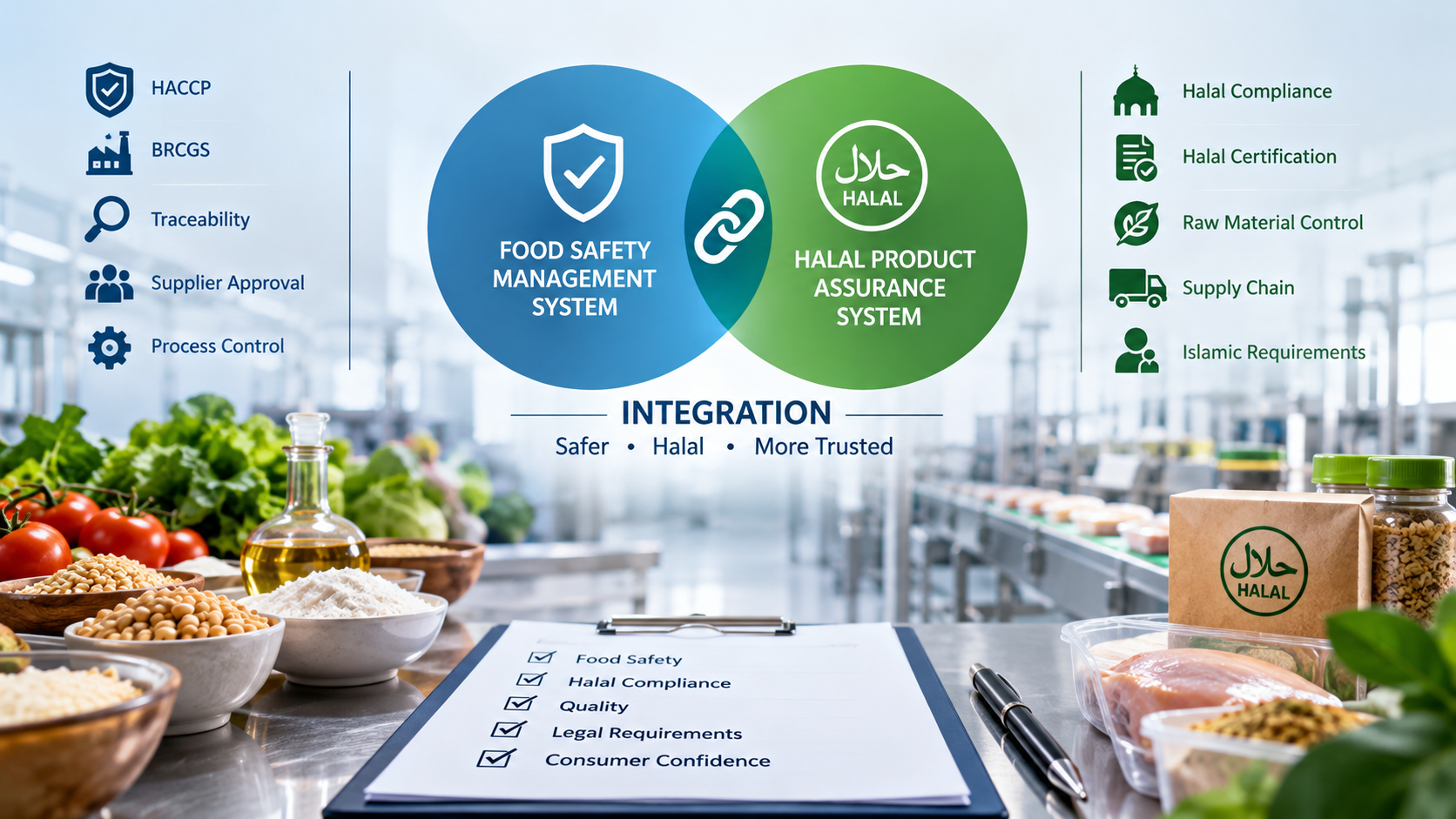
Consumer expectations in the food industry are no longer limited to product safety. Consumers increasingly expect food products to be safe for human consumption, legally compliant, traceable, of consistent quality and aligned with their religious requirements.
In this context, two important management systems come to the forefront:
- Food Safety Management System (FSMS): Aims to ensure that biological, chemical, physical and other relevant food safety hazards are identified, assessed and controlled.
- Halal Product Assurance System (HPAS): Aims to ensure that products comply with Islamic requirements throughout the entire supply chain, from raw material sourcing to final production and distribution.
Although these systems complement each other, they are not interchangeable.
For example, a gelatin product may be microbiologically safe, legally compliant and of high quality. However, if it is derived from porcine sources, it cannot be considered halal.
Similarly, a food product manufactured using halal-certified raw materials may still be unsafe if it contains pathogenic microorganisms or is exposed to serious chemical contamination.
Therefore, the fundamental principle should be:
Product integrity and consumer confidence can only be achieved when both food safety and halal compliance requirements are effectively fulfilled.
2. Understanding the Standards and Their Relationship
A successful integration requires a clear understanding of the scope, objectives and requirements of the relevant standards.
Food Safety Management
BRCGS Global Standard Food Safety Issue 9
BRCGS provides a framework for evaluating product safety, authenticity, legality, quality and operational controls within food manufacturing facilities.
Several key areas are directly relevant to halal assurance:
- Senior management commitment and food safety culture
- HACCP plans and hazard analysis
- Supplier approval and performance evaluation
- Raw material and packaging control
- Product and process control
- Allergen management
- Traceability and product recall
- Food fraud and food defence
- Cleaning and sanitation
- Personnel training and hygiene practices
- Change management
Halal Product Assurance
OIC/SMIIC 1:2019 – General Requirements for Halal Food
This standard addresses halal requirements throughout the food chain, including raw material sourcing, production, processing, packaging, storage, transportation and distribution.
OIC/SMIIC 18:2021 – Requirements for Halal Quality Management System
This standard is an important reference for establishing and implementing a halal quality management system.
OIC/SMIIC 2:2019 – Requirements for Bodies Providing Halal Certification
An important distinction must be made: OIC/SMIIC 2:2019 primarily establishes requirements for halal certification bodies rather than serving as a management system standard for food manufacturers. Nevertheless, it is an important reference for evaluating halal certification activities.
When these standards are considered together, it becomes clear that food safety and halal compliance can be managed through common operational processes while maintaining their distinct control requirements.
3. How Should Integration Be Implemented?
Integration does not simply mean combining procedures from two separate systems into a single document.
The main objective is to establish a unified operational structure in which common processes are managed collectively while the specific requirements of each system remain fully addressed.
3.1. Management Commitment and Organizational Structure
The first step is to define senior management’s responsibilities and commitment to both systems.
An integrated management team may include:
- Senior Management Representative
- Food Safety Team Leader
- Halal Assurance Officer
- Quality Assurance Manager
- Production Manager
- Purchasing Manager
- Warehouse and Logistics Manager
- Maintenance and Technical Services Representative
- Islamic Affairs Specialist, where required
A critical consideration is that food safety team members should not automatically be considered competent in halal compliance matters.
Likewise, halal assurance personnel should possess the necessary technical knowledge of HACCP, microbiological hazards and process control relevant to their responsibilities.
Roles, authorities and responsibilities must be clearly defined.
3.2. Integration of Hazard Analysis and Halal Risk Assessment
This is one of the most important stages of integration.
In a food safety management system, HACCP principles are applied to identify and assess biological, chemical and physical hazards.
In a halal assurance system, the source, composition, manufacturing process, potential contamination and Islamic compliance status of raw materials must also be assessed.
An essential principle must be emphasized:
HACCP hazard analysis and halal risk assessment are not the same analysis.
They may be managed using a common risk assessment methodology, but their evaluation criteria, acceptance conditions and control decisions must remain distinct.
A low food safety risk does not necessarily represent a low halal compliance risk.
For example, even if the probability of contamination with a porcine-derived ingredient is low, the potential impact on halal compliance cannot be treated as an ordinary acceptable food safety risk.
3.3. Supplier Approval and Raw Material Control
Supplier approval, raw material specifications and supply chain controls are important elements of BRCGS audits.
Within a halal assurance system, these controls must be extended.
Requesting only food safety certificates, laboratory analysis reports or technical specifications may not be sufficient.
Depending on the raw material, the following information should also be evaluated:
- Whether the raw material is of plant, microbial, synthetic or animal origin
- Animal species and applicable slaughter requirements for animal-derived materials
- Sources of enzymes, cultures and fermentation media
- Composition of flavours and additives
- Carrier and solvent materials
- Processing aids and process chemicals
- Auxiliary substances used during manufacturing
- Validity and scope of halal certificates
- Changes in raw material composition or manufacturing processes
Another important point is that the mere existence of a halal certificate is not sufficient. Its product scope, commercial name, manufacturing site and validity must be verified.
3.4. Production Areas, Equipment and Cross-Contamination Control
In food safety audits, cross-contamination is assessed in relation to allergens, microorganisms, chemicals and foreign materials.
In halal audits, additional attention must be given to contamination involving non-halal or najis materials.
The following subjects should therefore be addressed together:
- Separation of production lines or appropriate control measures
- Segregation of raw materials and finished products in storage areas
- Cleaning of production equipment
- Control of shared equipment
- Production scheduling
- Line cleaning during product changeovers
- Suitability of cleaning chemicals
- Rework management
- Waste management
- Personnel and equipment movement
In facilities using shared production lines, visual cleanliness or routine hygiene practices alone may not be sufficient to demonstrate effective cleaning and contamination control.
The applicable approach must be determined in accordance with the relevant halal standard and competent halal authority requirements. Where necessary, cleaning methods should be supported by verification, validation and documented evidence.
3.5. Traceability and Product Recall
From a BRCGS perspective, traceability must enable products to be tracked from raw materials through to finished products and support effective product recall when necessary.
From a halal assurance perspective, traceability must also demonstrate the ability to monitor and verify the halal status of products throughout the supply chain.
For example, if a flavouring ingredient used in a beverage manufacturing facility is found to have an invalid halal certificate or its composition has been changed by the manufacturer, the organization must be able to answer the following questions:
- On which dates was the relevant ingredient purchased?
- In which production batches was it used?
- Which finished products were affected?
- Which customers received the affected products?
- What is the current market status of those products?
- What decisions were made regarding their halal status?
- How were notification, product isolation and recall activities managed?
The product recall procedure should therefore address not only health-related risks but also situations that may affect halal compliance.
3.6. Change Management
One of the most frequently overlooked areas in food manufacturing is change management.
A change in raw material suppliers, product formulation, flavouring ingredients or production equipment may affect both food safety and halal compliance.
Consider the following example:
A manufacturer decides to replace its existing plant-derived emulsifier with an alternative emulsifier from a different supplier to reduce costs.
From a food safety perspective, the new ingredient may comply with specifications and laboratory requirements.
However, its production source must also be assessed to determine whether it is animal-derived and whether it complies with halal requirements.
Therefore, every change should trigger two fundamental questions:
- Does the change affect food safety risks?
- Does the change affect the halal status of the product?
Both questions must be evaluated, documented and approved.
4. How Should We Interpret Integration as BRCGS Lead Auditors and Halal Food Auditors?
As lead auditors, evaluating integration solely through the existence of procedures is not sufficient.
The real focus should be on how effectively the system is implemented and whether its control mechanisms function in actual operations.
In my view, five fundamental principles should guide the audit approach:
1. System Integrity: The organization must establish a clearly defined relationship between its food safety and halal assurance systems.
2. Risk-Based Approach: Risks associated with both systems must be assessed using their respective criteria and managed together where processes overlap.
3. Objective Evidence: Compliance must be verified through records, observations, laboratory results, certificates and personnel interviews rather than policies and procedures alone.
4. Competence: Personnel must understand both the food safety requirements and the halal compliance rules relevant to their responsibilities.
5. Continual Improvement: Internal audits, non-conformities, corrective actions and management reviews must address the performance of both systems.
An Important Auditor Consideration: Not All Non-Conformities Belong to the Same Category
Auditors must distinguish between:
- Food safety non-conformities
- Halal compliance non-conformities
- Non-conformities affecting both systems
- Systemic weaknesses or management system deficiencies
For example, inadequate cleaning of a production line may affect both food safety and halal compliance, depending on the nature of the contamination risk.
However, not every cleaning deficiency automatically constitutes a halal non-conformity. Similarly, not every halal non-conformity automatically creates a food safety non-conformity.
Auditors must evaluate the nature of the finding, its risk, the applicable standard requirement and the objective evidence together.
5. Documents That Can Be Shared Within an Integrated System
To reduce unnecessary documentation, organizations may manage the following documents within a common framework:
- Integrated Food Safety and Halal Policy
- Integrated Risk and Opportunity Assessment Procedure
- HACCP Plan and Halal Risk Assessment
- Supplier Approval and Evaluation Procedure
- Raw Material and Packaging Control Procedure
- Production and Process Control Procedure
- Cleaning and Sanitation Procedure
- Cross-Contamination Prevention Procedure
- Traceability and Product Recall Procedure
- Change Management Procedure
- Non-Conformity and Corrective Action Procedure
- Training and Competence Procedure
- Internal Audit Procedure
- Management Review Procedure
Combining these documents does not mean eliminating the specific requirements of each standard.
Each applicable requirement must have clearly defined responsibilities, control methods, implementation criteria and records.
6. How Should the Effectiveness of Integration Be Measured?
The success of an integrated system should not be measured solely by the number of certificates obtained.
Organizations may monitor the following performance indicators:
- Percentage of approved suppliers with verified halal compliance
- Success rate of halal certificate validity monitoring
- Percentage of approved raw materials used in production
- Number of food safety non-conformities
- Number of halal compliance non-conformities
- Cleaning and sanitation verification results
- Traceability test success rate
- Product recall exercise results
- Personnel training and competence levels
- Number of raw material and process changes assessed through change management
- Effectiveness of corrective actions
These indicators should be evaluated together during management review meetings to determine the effectiveness of the integrated system.
7. Conclusion: An Integrated Approach to Safe, Halal and Reliable Food Production
The integration of food safety management systems and halal product assurance systems is becoming a strategic necessity in today’s food industry.
International food safety standards such as BRCGS strengthen product safety, quality, legality and operational control mechanisms, while halal assurance systems ensure that products comply with Islamic requirements from raw material sourcing to the final consumer.
From the perspective of a BRCGS Lead Auditor and Halal Food Auditor, the fundamental principle is to recognize that these two systems are not alternatives to one another; they are complementary.
Food safety aims to ensure that products are safe for human consumption, while halal assurance aims to ensure that products comply with Islamic requirements. A truly integrated system must deliver both assurances within the same supply chain and operational discipline.
At TAKVA International Certification, we believe that strengthening reliable production practices through halal compliance, management systems and international standards contributes significantly to the competitiveness of the food industry in international markets.
Reliable production requires sound management, effective controls and sustainable halal assurance.
#TAKVACertification #FoodSafety #HalalFood #BRCGS #BRCGSFoodSafety #HalalAssurance #FoodSafetyManagement #HalalCertification #OICSMIIC #HACCP #FoodQuality #HalalSupplyChain #IntegratedManagementSystems #FoodIndustry #HalalCompliance
Start your halal certification process
Submit your application online and our experts will get back to you with a tailored offer and roadmap.