
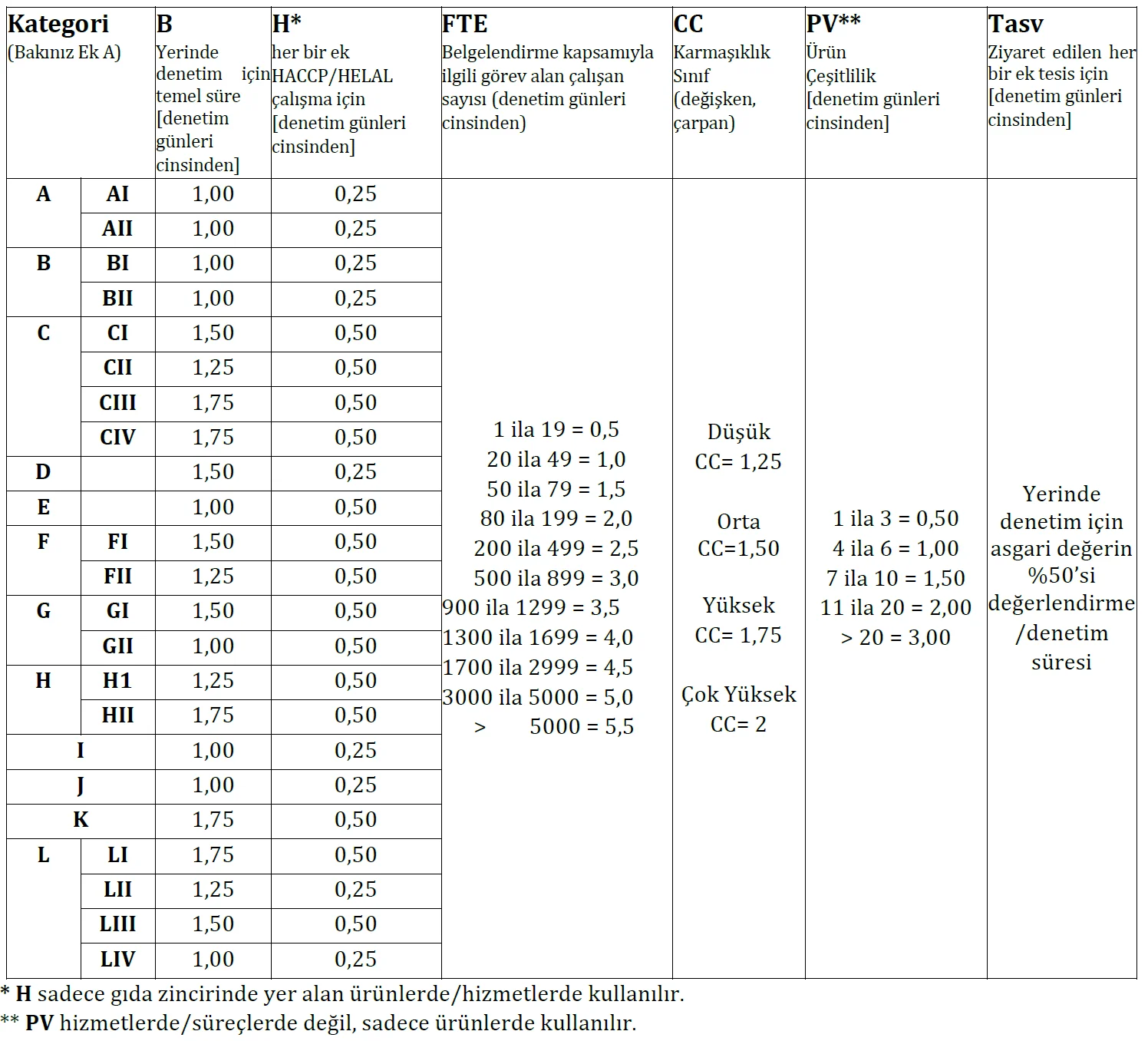
When determining the time required for each site audit under clause 9.1.4 of OIC/SMIIC 2:2019 (a standard similar to ISO/IEC 17021-1), the halal certification body shall take Table B1 into account for the minimum on-site audit time for initial certification. The minimum time includes stage 1 and stage 2 of the initial audit (see OIC/SMIIC 2:2019 clause 9.2.3) but does not include the time needed for audit preparation and for writing the audit report.
The minimum surveillance audit time shall be one third of the initial certification audit time, with a minimum of 0.5 audit day. The minimum recertification audit time shall be two thirds of the initial certification audit time, with a minimum of 0.5 audit day. Where there is no relevant certified halal product/process/service or management system, additional time shall be added to the audit. To be considered relevant, the management system certificate must cover the food safety scope of the relevant product/process/service. The number of employees shall be expressed as the number of full-time equivalent employees (FTE) working on matters related to the certification scope.
Multi-site sampling is only possible for categories A, B, E, F and G and for organisations with more than 20 sites operating similar processes in these categories. This requirement applies to initial certification, surveillance and recertification audits. The certification body shall justify the sampling method it decides on for multi-site certification.
Other factors may require the minimum audit time to be increased (e.g. number of product types, number of product lines, product development, number of halal critical control points (CCPs), number of active PRPs, building area, infrastructure, in-house laboratory testing, need for an interpreter).
For all audit types, the audit time covers the total time spent at the client's premises (physically or remotely) and the time spent outside the premises on planning, document review, interaction with client personnel and report writing.
In general, the on-site audit time for halal certification should not be less than 70% of the audit time calculated using the methodology given in OIC/SMIIC 2:2019 clause B.2. This requirement applies to initial certification, surveillance and recertification audits. The halal certification body may increase or reduce the audit time by presenting appropriate and valid justifications. Any reduction shall not exceed 30% of the audit time calculated according to OIC/SMIIC 2:2019 clause B.2.
Calculating the minimum audit time for initial certification
Minimum audit time for a single site:
Ts: TS = TD + TH + (TPV + TFTE) × CC
Where TD is the basic on-site audit time (days);
TH is the number of audit days for each additional HACCP/halal CCP product group study, applied only to the group of products/services/processes in the food chain. If the company has 1 HACCP/halal CCP study, H is taken as "0". The number of audit days is increased for each additional study; for other types of products/services/processes this value may be taken as "0". TPV is the number of audit days according to product variety, TFTE is the number of audit days per number of employees, and CC is the multiplier applied according to the process or production complexity class. If the calculated Ts value is a decimal, the number of days is rounded to the nearest half day (e.g. 5.3 becomes 5.5 audit days, 5.2 becomes 5.0 audit days).
or
If the calculated TS value is a decimal, the number of days is rounded up to the next whole or half day (e.g. 5.3 becomes 5.5 audit days, 5.7 becomes 6 audit days). B.2.2 Minimum audit time for each additional site:
Tasv = TS × 50/100
Start your halal certification process
Submit your application online and our experts will get back to you with a tailored offer and roadmap.
Last updated: November 3, 2026