
When a nonconformity is found during an audit, most companies rush to fix it: they change the label, complete the missing document, or warn the staff. But if you never find out why the problem happened, the same nonconformity will show up again at the next audit. Root cause analysis is essential to keep halal assurance working over time.
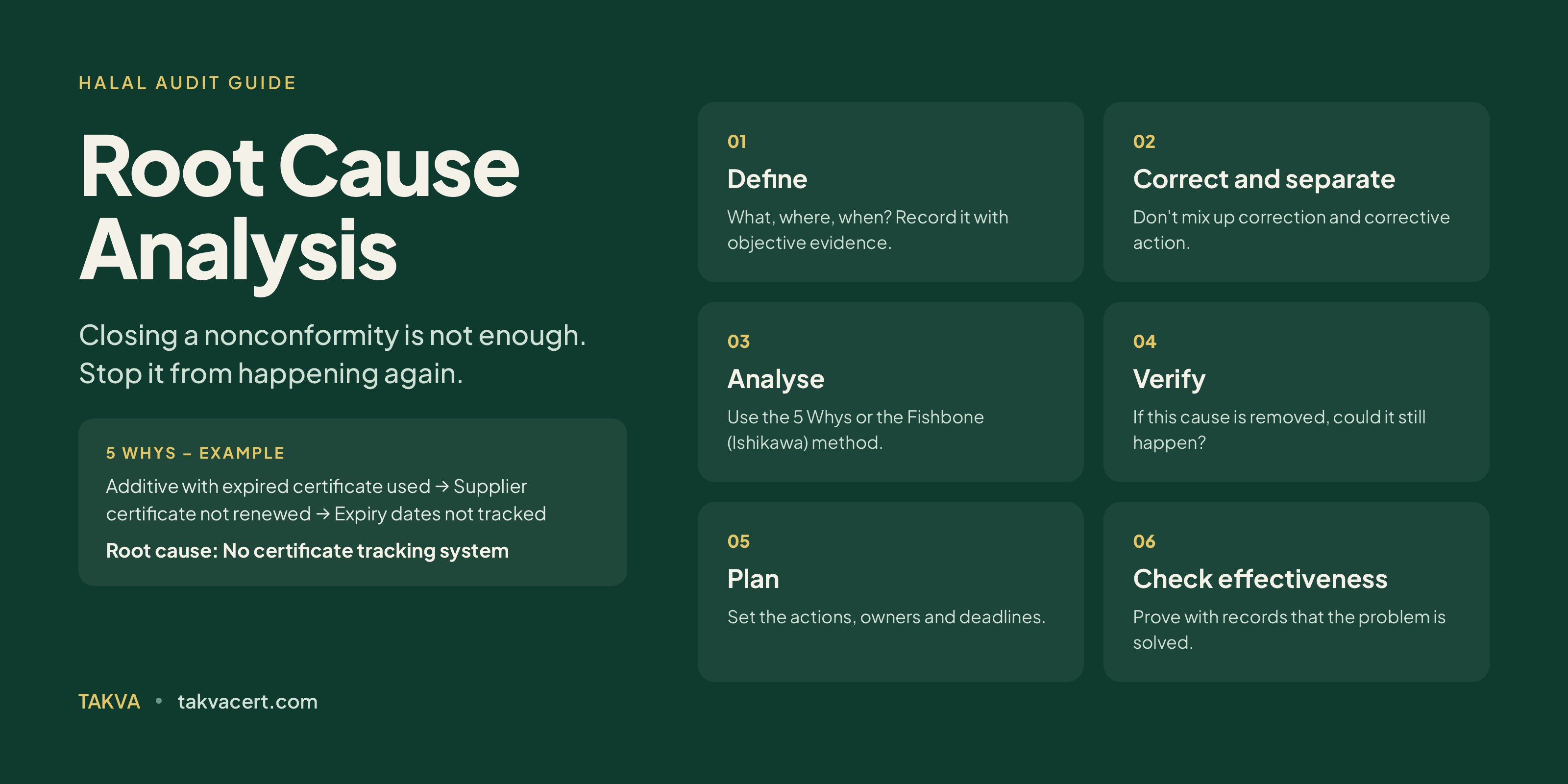
1️⃣ Define the nonconformity clearly
What happened, where, when, and in which product or batch? Stick to objective evidence and leave out interpretation.
2️⃣ Separate correction from corrective action
• Correction: fixing the immediate problem (e.g. setting aside the suspect raw material).
• Corrective action: removing the root cause so the problem does not happen again.
3️⃣ Use the right method
• 5 Whys: Keep asking "Why?" until you reach a cause in the system.
• Fishbone (Ishikawa) diagram: Look for possible causes under Man, Method, Material, Machine, Measurement and Environment.
📌 Example: An additive with an expired halal certificate was used in production.
→ Why? The supplier's certificate was not renewed.
→ Why? Nobody tracks certificate expiry dates.
→ Why? The approved supplier list has no expiry date field, and no one is responsible for checking it.
✅ Root cause: There is no system for monitoring suppliers' halal certificates.
❌ "Carelessness of the purchasing staff" is not a root cause.
4️⃣ Verify the root cause
Ask: "If this cause were removed, could the problem still happen?" If the answer is "yes," you have not found the root cause yet.
5️⃣ Build a lasting action plan
Set out each action, who is responsible and the deadline. Check other processes that carry a similar risk too.
6️⃣ Verify effectiveness
Finishing the action is not enough. After a set period, review the records to show the problem has really been solved.
⚠️ Common mistakes
• Putting the root cause down to "human error" and moving on
• Answering every nonconformity with "training was provided"
• Presenting a correction as a corrective action
• Skipping the effectiveness check
A well-done root cause analysis shows the auditor that your company has done more than close the finding. It has made its halal assurance system stronger.
📩 For halal certification applications and information:
🌐 https://www.takvacert.com/helal-basvuru
📞 +90 554 433 60 66
✉️ info@takvacert.com
#HalalCertification #RootCauseAnalysis #HalalAudit #CorrectiveAction #HalalAssurance #JAKIM #TAKVA #FoodSafety
Start your halal certification process
Submit your application online and our experts will get back to you with a tailored offer and roadmap.